Information and Communication Technologies (ICT)

A combination of methods, production processes, and software and hardware tools integrated for the purpose of collecting, processing, storing, distributing, displaying, and using information to meet the needs of its users.

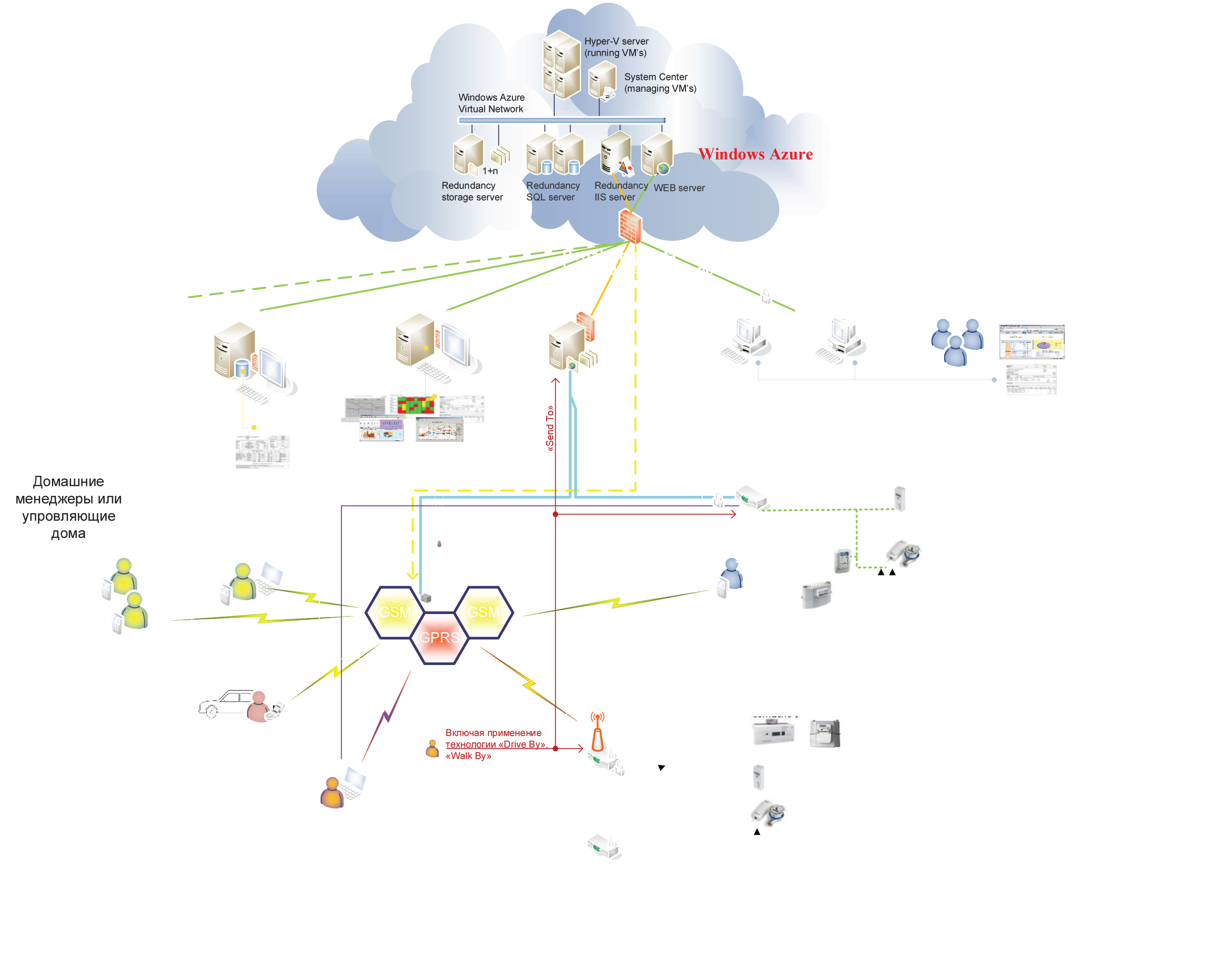
Schematic Diagram of the Automated Metering System

The implemented energy-efficient long-range network is shown in the diagram. This network allows users to view and verify readings from hot and cold water flow meters or allocators, with the collected data subsequently used to prepare automated recalculations.

To ensure guaranteed and secure 24/7 access to the metering system, the website is available at id.myecolife.net

Implementation of the MyEcoLife Cloud 1.0 Platform for Public Utilities

Objective

To automate resource consumption metering in the public utilities sector, ensuring transparent billing, reduced costs, and convenient access to data for users.

Solution

The MyEcoLIfe Cloud 1.0 cloud platform was implemented to enable:

  • Management companies and property developers to reduce IT infrastructure costs.
  • Residents to monitor consumption and recalculations online.
  • Automatic collection and analysis of data without human intervention.
  • Reliable data storage even when the management company changes.

Results

  • Up to 75% reduction in resource management costs.
  • 24/7 service availability with minimal capital investment.
  • Flexible and scalable solutions for any type of property.

Company Technologies

Low-Power Wide-Area Networks (LPWAN)

The company uses LPWAN (Low-Power Wide-Area Network) technologies to create distributed networks with low power consumption and wide coverage. This is an ideal solution for:

  • Telemetry and telemechanics
  • Remote monitoring of IoT devices (meters, sensors, and detectors)
  • Machine-to-machine communication (M2M)
Key LPWAN Technologies:
  • LoRaWAN — an open protocol designed for long-range communication, with devices capable of operating autonomously for up to 10 years
  • NB-IoT — a cellular IoT solution with guaranteed quality of service (QoS)

LoRaWAN Architecture

The network is built on:

  1. End devices — sensors and IoT devices
  2. Gateways — receive data and transmit it to the network via Ethernet, Wi-Fi, or cellular connectivity
  3. Network server — manages the network and adapts the data transmission rate
  4. Application server — collects and analyzes data

Benefits of LoRaWAN:

  • Global coverage (up to 20 km per gateway)
  • Low power consumption (batteries can last up to 9 years)
  • Security: AES encryption at three levels
  • Support for up to 5,000 devices per gateway

Device Classes:

Class A — minimum power consumption (data is transmitted on device request)
Class B — synchronized data reception (according to a schedule)
Class C — continuous reception (for applications requiring high data volumes)

LoRaWAN vs. NB-IoT Comparison

Criterion LoRaWAN NB-IoT
Power Consumption Low (asynchronous protocol) Moderate (regular synchronization)
Cost Lower (modules from $5) Higher (modules from $20)
Coverage Up to 20 km (private and enterprise networks) Depends on LTE infrastructure
Applications Remote monitoring, M2M Applications with guaranteed QoS
Benefits of LoRaWAN:
  • Rapid deployment (ready-to-use solutions)
  • Flexibility: private and hybrid networks
  • Ideal for low-traffic devices

Implementation Example: MyEcoLife Cloud 1.0

Implemented network for automated resource metering:

  • Real-time monitoring of water meter readings
  • Secure 24/7 access via a web interface
  • Integration with automated recalculation systems

A Non-Standard Requirement?

We will develop an individual solution and support you at every stage.

Submit a Request